
Municipalities in Pennsylvania are allowed to merge with each other, but that‘s often impractical. Towns and cities that are struggling to hang on don’t want to assume the debt or budget problems of a community that’s in worse shape than they are. That’s one reason there have been only five municipal mergers in the whole state since 2000.Pennsylvania has more local governments than all states save Texas and Illinois.
Showing posts with label fragmented governance. Show all posts
Showing posts with label fragmented governance. Show all posts
Tuesday, August 21, 2018
Should Smaller Towns Be Allowed to Disband?
According to Governing, Allegheny County Exec Rich Fitzgerald is pressing state lawmakers to allow shrinking municipalities to simply disband and allow the county to control some services. Under current law,


Tuesday, September 09, 2014
West Easton Not Only One-Horse Town in Northampton County

He was rejected in favor of another guy who was not there.
Mezzacappa, who is currently hiding her car from the Sheriff, walked down to call Kelly Gross a felon and then left. Some people attending their first ever meeting reportedly walked out, too.
This was my kind of meeting.
Fortunately, Express Times editor Jim Deegan and West Easton blogger Matt Dees attended, and will have factually accurate accounts.
Let me tell you about another tiny borough at the other end of the County.
North Catasauqua is smack dab along the Lehigh River, right above Northampton. Developer Joe Keglovits has been president of a five-person borough council as long as I can remember, though nobody's really sure whether he lives really there or in Northampton. His son John Keglovits and son-in-law Matthew Barber are members of Council, too, giving this family effective control.
Here's an interesting story I heard on Sunday. I got this this from one person, so I can't claim it's accurate, but here goes. About two years ago, when a vacancy opened up in the borough for a PT secretary, the position initially went to Barbara Barber. She's Joe Keglovits' daughter and is married to Council member Matt Barber. Questions of nepotism arose, but the answer was that she was the only person who applied.
Until someone discovered the job vacancy had been advertised in The Brodheadsville Gazette.
I think it's pretty apparent that the problem is not West Easton. It's all small boroughs. Pennsylvania has the second highest number of local governments in the nation, including 958 boroughs. Their residents pay higher taxes than townships, and for less services. It is not the people in the government, but the government itself that needs to change. It is simply too fragmented.
Monday, May 02, 2011
Is Now a Good Time To Consolidate School Districts??
 At a budget hearing last week, Bethlehem School Superintendent Joseph Roy quickly dismissed a suggestion that it's time for school districts to consolidate. "It will never happen," he predicted. Here's why. Voluntary consolidation would require people like Roy, a horde of top-heavy administrators at nearly every school district, to look for another job. So Dr. Roy would much rather raise your taxes. I can certainly understand his prediction, but I think he's wrong. Consolidation may be closer now than ever.
 Everyone is up in arms over Governor Corbett's no-tax hike budget. I saw that last week, too, at a community forum in which four of our local state representatives got an earful. What has them most angry are the education cuts. Basic funding is slashed $550 million, along with $260 million in school district grants for kindergarten and prekindergarten. On top of that, $650 million for higher education is gone.
 Corbett insists he's merely returning funding to the 2008 prestimulus levels, and blames both the feds and school districts, who were warned that the stim package was only temporary.
While that's certainly true, it's only part of the story. In Bethlehem, for example, returning to 2008 levels would mean a reduction of $2.5 million. But Corbett has cut $7 million. In Allentown, a return to prestimulus levels would mean a $8 million cut. But the state has cut its funding to Allentown by $15 million. State Rep. Steve Samuelson, who has done the math on individual school districts, claims that statewide, stimulus money for education was $654 million. Corbett has cut $1.1 billion.
Between now and the actual adoption of a budget, Corbett has hinted he's open to restoring some of these educational cuts. But the party's over. Like it or not, Corbett is unwilling to raise taxes, and school districts are now facing a teacher pension tsunami next year, when they will have to start paying an addition $2.5 billion for retiring teachers.
Consolidation of the state's 500 school districts is fast becoming an economic necessity. State Senator John Wozniak introduced legislation last year that would provide for county-wide school districts. Locally, Lisa Boscola signed as a sponsor.
In the House, legislation approving a referendum to consolidate Fayette County is being considered. School districts would still maintain their separate identity, but there would be one county administration. Locally, Bob Freeman and Jennifer Mann have signed as sponsors.
Sumter County has already decided to consolidate its two school districts into one, effective July 1.
Naturally, superintendents and school boards have commissioned studies showing that consolidation will end the universe. They'd much rather lay off teachers. Or raise taxes. But as one school director told The Pittsburgh Tribune, "You don't have to be a Wall Street businessman to see the savings."
Thursday, June 15, 2006
The Lehigh Valley: A Fragmented Mess
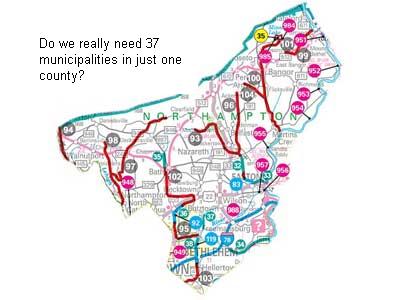 Last time I told you about Upper Macungie Township, where township supervisors are trying to explain inflatable dolls and questionable township expenses to state regulators. Bill White believes the second class township code, which allows supervisors to hire themselves, is part of the problem. I agree, but think there's another reason.
The Lehigh Valley is a fragmented mess, a challenge for any lover of jigsaw puzzles. It's a quagmire of Upper and Lower Saucons, Milfords, Macungies, Nazareths, and Mount Bethels. We've got North and South Whitehall, Allen and East Allen, Catty and North Catty, Bangor and East Bangor, and Easton and West Easton. We're a morass of 62 separate municipalities and 2 counties. On the local level, we elect 466 officials to represent 578,500 people, or 1 local and paid elected official for every 1240 residents. And this is without looking at our 17 school districts.
The Lehigh Valley is not unusual. Pennsylvania possesses "one of the nation's most labyrinthine systems of state and local government." Its 2566 municipalities is the third largest total of general governments in the nation, according to a recent Brookings Institute report.
So what's the big deal, you may ask. Isn't government supposed to be close to the people? Well, yes. But having so many of them has the opposite effect - it makes local government both weak and unresponsive. That's certainly what's going on in Upper Macungie. Let me give you some examples.
First, our fragmented governance enables developers to run roughshod over haphazard municipal land use plans and local zoning. That's why open space referenda are really just a joke. They do nothing but create little playlands for all the McMansions.
Second, because we're such a mess, the state can ignore us. Parochial concerns prevent us from agreeing on anything, whether it's the location of a baseball stadium or a casino. Municipalities compete over business locations, luring a business like Lehigh Valley Plastics from another location just a few miles away. State officials can play municipal officials against each other, which keeps them weak. We could be much more forceful if we were united.
Third, because we are so divided, unelected groups like the LVPC can set our agenda. Although much of the LVPC's work is excellent, their mandate does not come from the people, and that is reflected by their "public" hearings, which are almost always scheduled when those of us who work are unable to attend. Elected municipal officials are hesitant to question LVPC recommendations because their municipalities are unable to fund studies that might reach different results.
The final and most serious problem is a fragmented response to pandemics, natural disasters, or our coming energy crisis. Most of the Valley's major businesses already have plans in place. Our local governments, however, are simply not equipped to deal with these problems, and instead pretend the problem is not there.
Our two County execs, John Stoffa and Don Cunningham, recognize the importance of a regional approach to the Lehigh Valley's problems, and have begun exploring areas where government services can be consolidated. So far, they're mostly discussions, and no one has even broached the idea of consolidating a few municipalities or merging Northampton and Lehigh Counties.
One example of the difficulties faced, both by Stoffa and Cunningham, is in the idea of a regional health authority. Northampton County Council recently authorized the study of a regional health authority, which makes perfect sense in the face of a pandemic or natural disaster. Those won't stop at municipal boundaries. Yet Councilmen Lamont McClure, Charles Dertinger, and Wayne Grube voted against this salutary proposal, defying common sense with parochialism.
Regional problems require regional solutions. And perhaps it's time to consider one Lehigh Valley County, but that won't happen in my lifetime.
Subscribe to:
Posts (Atom)